How Rake Changes Your PLO Preflop Strategy: Low vs. High Stakes

How should rake influence your PLO game plan?
This article follows our comparison of optimal strategies at 100 BB and 200 BB. This time, we’ll examine the differences between low and high stakes. Does higher rake really mean you should play much tighter at low stakes? Let’s find out.
For this comparison, we’ll use the higher-rake settings for PLO50 and the lower-rake settings for PLO5000, both at 100 BB. To do this, we’ll use the Compare tool in PLO Genius, which lets you examine how optimal strategy changes between different configurations within the same game.
How Does Rake Affect Your Opening Ranges?
Let’s start with the most obvious comparison: opening ranges for each position.
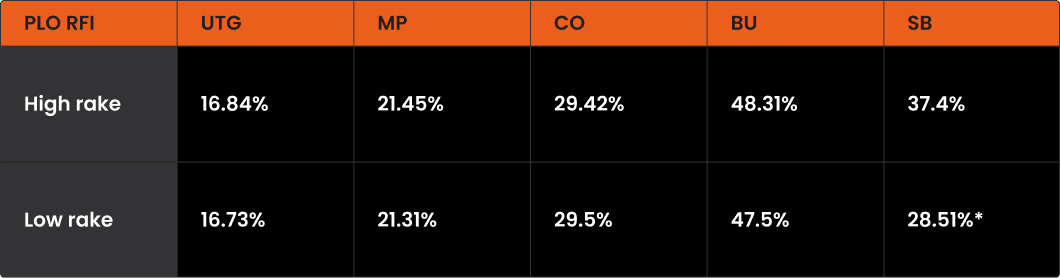
*The Small Blind limps 24.34% of hands in the low-rake environment.
As you can see, when the action folds to you at 100 BB, rake has relatively little effect on opening ranges outside the Small Blind. Most ranges are similar, and lower rake does not mean you should open wider at higher stakes.
That changes in the Small Blind. At PLO50, you should play 37.4% of your hands, all as open raises. At PLO5000, your total VPIP increases to 52.85%: 24.34% of all hands are limps, and 28.51% are open raises.
That means more than just playing additional hands. It also adds another part of the preflop strategy to learn: limping and responding to a Big Blind isolation raise.
Looking more closely at the Small Blind’s limping range, we find many hands with a suited Ace, double pairs, and hands containing KK or QQ. These hands often benefit from seeing a flop, but some are less comfortable calling a 3-bet after opening. Limping gives them a way to enter the pot and call a Big Blind isolation raise.
A limping range also needs strong hands that can limp and reraise. This is reflected in some AA hands moving from the Small Blind’s opening range into its limp-reraise range.
How Does Rake Affect Cold-Calling and 3-Betting?
Things get more nuanced when we compare cold-calling and 3-betting against an open. Let’s look at how each position should respond to an UTG raise under both rake structures.
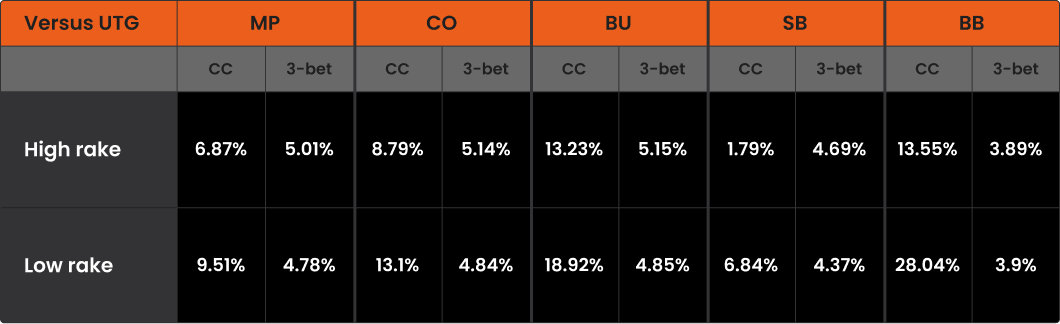
For the most part, 3-betting frequencies and range compositions remain similar. The frequency differences are only fractions of a percentage point.
Cold-calling ranges change much more. At a lower rake, every position calls more hands. In MP, the calling range grows from about 18,000 to 25,700 combos, with the frequency increasing from 6.87% to 9.51%. In the Big Blind, it grows from about 36,600 to 75,900 combos, an increase from 13.55% to 28.04%.
These are substantial differences. As rake decreases, more calls become profitable, especially when defending the blinds.
In the Big Blind, the additional calling hands come from several categories. High pairs such as KK and QQ are called more often, along with connected hands such as KQT9 rainbow, 9876 single-suited, and 9754 with three cards of the same suit.
Now, let’s move the opening raiser to the Button and see how the blinds respond.
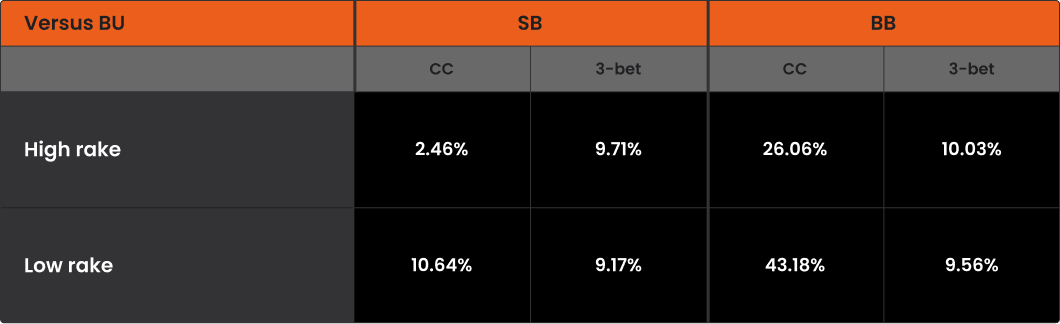
Once again, the blinds play significantly more hands at lower rake. The Small Blind calls more than four times as often, increasing from 2.46% to 10.64%, while its 3-betting frequency remains very similar. That means adding many calls that would be folds under the higher-rake structure.
The Big Blind’s defense also changes significantly. Against a Button open at PLO5000, it continues with more than half of its hands: 43.18% by calling and 9.56% by 3-betting. That gives a total defense frequency of 52.74%, compared with 35.09% at PLO50.
The wider calling ranges include more suited combinations and Ace-high hands, such as 5432 double-suited, 8764 single-suited, AK94 with a suited King, and AQ97 with a suited Nine.
How Does Rake Affect Calling and 4-Betting Against a 3-Bet?
Lastly, let’s look at how your response to a 3-bet changes with rake, both in position and out of position.
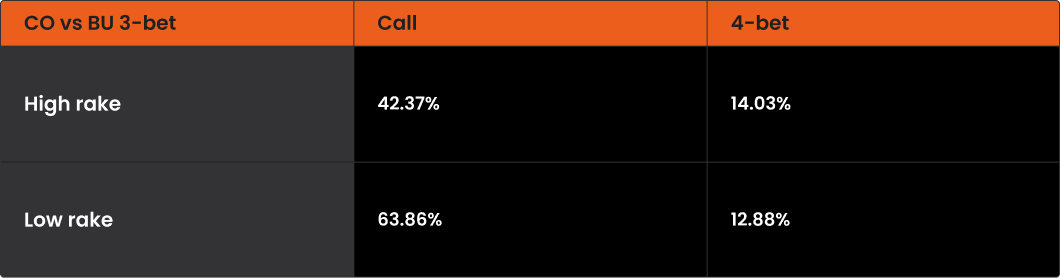
Start with an out-of-position example: you open from the CO, the Button 3-bets, and the action returns to you.
For the in-position example, you open from the Button and face a Small Blind 3-bet.
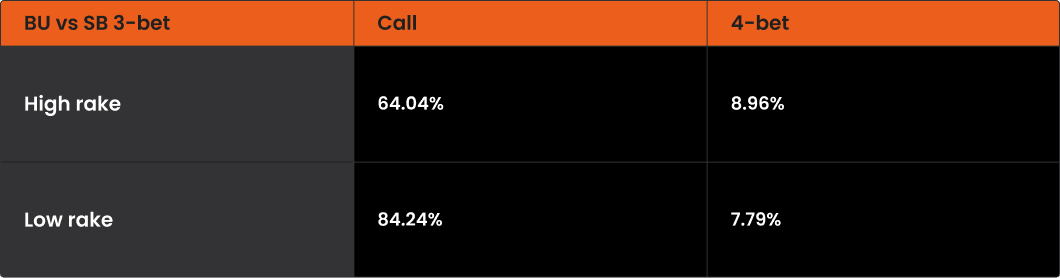
Once again, the raising frequency — 4-betting in this case — changes only slightly. Calling is where the main difference appears.
At lower rake, you should call with a larger share of your opening range in both situations. This adds about 17,000 calling combos in the CO against the Button and 24,000 on the Button against the Small Blind.
Out of position, the value of a suited Ace stands out again. Most hands with a suited Ace continue against the 3-bet, with even middling combinations such as AKT5ss, AKJ7ss, and AJT5ss becoming pure calls.
In position, the lower rake leaves very few folds. The hands that do fold are mostly those that struggle to make the nuts. At PLO5000, even AK83r, AQ83ss, and KJ75ss become calls against a Small Blind 3-bet.
Adjust Your PLO Strategy to the Rake
Overall, lower rake makes calling profitable with more hands in many common preflop situations. You can cold-call more often against an open, defend wider from the blinds, and fold less against 3-bets.
In these comparisons, most opening and reraising frequencies remain relatively stable. The biggest adjustments come from expanding your calling ranges—and, in the Small Blind, adding a limping strategy.
Rake is just one of the factors you can compare in PLO Genius. Explore how stack depth and other game settings change your strategy, too. See what else PLO Genius can do.

Subscribe to our newsletter
Stay up to date with our new features
Join our community on Discord!
Want to learn more about PLO?
Catch up on our latest articles, updates, and insights

How to Get More Out of PLO Genius
Get more out of your PLO Genius study sessions with these practical tips.

How Stack Depth Affects PLO Preflop Strategy
What changes preflop when stacks go from 100bb to 200bb in PLO: RFI, 3-betting in and out of position, with numbers from the Compare tool.

Same Hand, Different Table: What Actually Changes Your PLO Strategy
Same hand, different rake or table size: the Compare tool shows which hands change their preferred action and by how much EV, with a PLO50 vs PLO5000 example.
