How to React Versus 3-Bets When You’re in Position

Most PLO players tend to avoid 3-betting out of position unless they hold a premium hand (namely AA combos). That’s understandable - developing a coherent strategy takes preparation, and playing big pots OOP is always challenging.
As a result, you’ll face 3-bets from the Small and Big Blind less often than theory suggests. Still, they remain an essential part of the game - and so does knowing how to react to them.
Thanks to positional advantage, playing as the preflop caller in a 3-bet pot is relatively straightforward compared to being out of position. Even so, it’s a spot worth examining in detail.
Theoretical vs Expected 3-Bet Frequencies from the OOP Player
As we’ve discussed in our article on out-of-position 3-bets, the overall 3-bet frequencies from the blinds are somewhat similar. However, since the Small Blind gains more from 3-betting, we’ll focus on playing against that position here.
Let’s start with looking at the theory; below you will find the PLO Genius recommendations for Small Blind 3-bet ranges versus different opening positions:

As we’ve mentioned, your average opponent will likely 3-bet less frequently than theory prescribes. That’s good news - it allows you to realize more of the expected value from your marginal hands.
Still, to build a solid theoretical foundation, let’s assume for a moment that your opponent is playing close to Game Theory Optimal - or that you’re training with the PLO Genius Trainer.
So, what do the optimal frequencies versus an out-of-position 3-bet look like?
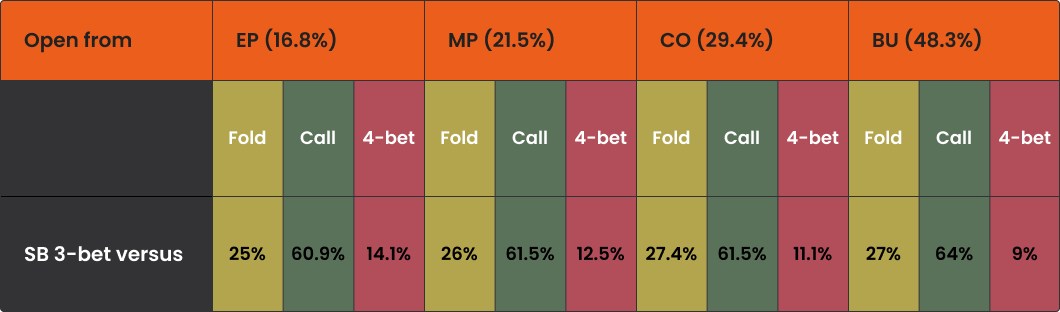
As you can see, against a properly wide 3-betting range, there’s relatively little folding and a fair amount of 4-betting (we’ll dive deeper into the exact 4-bet construction in a separate article).
One necessary clarification: the calling frequencies are always relative to the opening ranges.
- For example, if you open UTG and then call an SB 3-bet, a calling frequency of 60.9% translates to roughly 27K combos.
- On the other hand, if you open from the Button, a similar calling frequency of 64% equals nearly 83K combos - a much larger and quite different set of hands in practice.
This difference comes from the fact that your initial opening ranges vary greatly by position:
- UTG: ~45K combos
- Button: ~130K combos
Although the percentages may appear comparable, the actual ranges behind them are significantly different.
Reacting to 3-Bets in Position: When to Call, Fold, or 4-Bet
As you’ve probably noticed, an average PLO player folds very little in position versus a 3-bet, usually defaulting to calling. The power of positional advantage in PLO allows many players to “get away with it,” but you’ll do much better by adopting a disciplined approach when weighing your options against an out-of-position 3-bet.
Keep in mind that most opponents will have ranges that are too AA-heavy compared to what theory suggests. That means the theoretical GTO calling ranges are wider than what you should do in practice.
Let’s look at the overall principles of how your strategy should be constructed versus a Small Blind 3-bet.
Playing in Early Position Versus a Small Blind 3-Bet
When in early position, your range should remain tight and well-structured.
- 4-Bets: Almost all of your 4-bets here come from AAxx hands.
- Kings and Queens: AKKx and AQQx hands can usually continue if they’re suited, especially with the Ace-high suit.
Kings without an Ace are mainly continued when they’re double-suited or double-paired. - Double-paired and double-suited hands are excellent continues. If they’re strong enough to open in EP, they’re usually strong enough to call a 3-bet.
- Among the weakest hands you can still continue with are those that have an Ace-high suit combined with some additional playable component, such as a pair, or the best single-suited connected hands like KJT8.
Remember, when in doubt with borderline hands, err on the side of folding - since most real-life opponents are under-3-betting, your discipline will save you money long term.
Playing on the Button Versus a Small Blind 3-Bet
The biggest difference from EP play shows up in the 4-betting frequency.
- From the Button, theory recommends ~9% of 4-bets compared to ~14.1% when you’re in Early Position. In raw numbers, that’s ~11.7K combos versus ~6.4K combos from EP.
Much of this increase comes from hands like AQQx (which unblock potential KKxx 3-bet/folds and play relatively well versus hands calling 4-bets) and from well connected double-suited hands with an Ace.
In addition to 4-betting more, you can also call wider:
- Broadway Connectivity: Continue with a variety of well-connected broadway hands, such as QQJ9ss, KQQ5ss, or even mid-pairs with connectivity like 9766ss and 8775ss.
- Ace-High Non-Nut Suits: Hands such as AJT7, AQJ9, or A543 can also be continued, even when the suit you have is not to the nuts.
As we've mentioned earlier, remain mindful of opponent tendencies. Calling too wide without a nut component can put you in tough spots against AA-heavy ranges - which will often hit nut flush draws, weakening your own draws.

Remain Vigilant
As always, your in-position strategy versus 3-bets should be well thought out and adaptable. Against most opponents, you can - and should - fold more than GTO recommends, since you’ll often be facing stronger-than-theoretical ranges. At the same time, don’t hesitate to leverage your positional advantage when you expect your opponent to make significant postflop mistakes.
To sharpen your overall PLO instincts, practice with the PLO Genius Trainer. It will help you:
- Recognize which hands should continue in different spots
- Compare hand strengths within your range
- Train disciplined responses against realistic opponent tendencies

Subscribe to our newsletter
Stay up to date with our new features
Join our community on Discord!
Want to learn more about PLO?
Catch up on our latest articles, updates, and insights

How to Get More Out of PLO Genius
Get more out of your PLO Genius study sessions with these practical tips.

How Rake Changes Your PLO Preflop Strategy: Low vs. High Stakes
Does higher rake mean you should play tighter in PLO?

How Stack Depth Affects PLO Preflop Strategy
What changes preflop when stacks go from 100bb to 200bb in PLO: RFI, 3-betting in and out of position, with numbers from the Compare tool.
