Bankroll Management & Variance in PLO. What Should You Expect, and How Should You Prepare Yourself?


Variance in Pot-Limit Omaha is significantly higher than in other poker formats — understand what drives it and how to prepare both strategically and mentally.
Whichever poker format is your favourite, if you want to grow as a player, you need to understand variance's influence on your results and, subsequently, how you should approach your bankroll management. Studying with a PLO solver improves your decisions; understanding variance tells you what those decisions will look like over a sample.
Variance is a word that frightens many poker players. We can't blame them, as whenever the bad run gets you, it feels like there's not much you can do about it. But are you really so powerless in such situations? Let's find out.
The first step to minimizing the negative influence of variance on your results and mental state is understanding how it works. Therefore, in this article, we'll look at how bad (or good) you can expect to run when playing PLO, what you should be prepared for, and how big your poker bankroll should be.
Why and when do we talk about variance in poker?
Variance is a term derived from statistics that measures how far a set of numbers is spread out from their average value. When it comes to poker, the term variance is used to describe how lucky or unlucky you can get under certain conditions.
The most common use of variance in poker is estimating the possible outcomes of playing a set number of hands or tournaments. Knowing how far your results can swing over your regular games allows you to decide how big your poker bankroll should be so you can play comfortably without an excessive risk of ruin.
The human mind naturally has trouble comprehending many probability-related issues. Due to our natural tendencies, we fall prey to cognitive biases. We often underestimate or overestimate the influence of luck on the results of our actions. Therefore, our intuitive view of variance is flawed by default.
How do we combat these natural adversities? With the help of poker tools, naturally. One such tool is a primedope Poker Variance Calculator. It allows you to simulate the possible outcomes of your plays under specific circumstances. With the help of the Variance Calculator, you can study various potential scenarios, such as how your win rate, the number of hands you play, and the format you choose influence each other.
Let's dive in and see what the range of possible outcomes is.
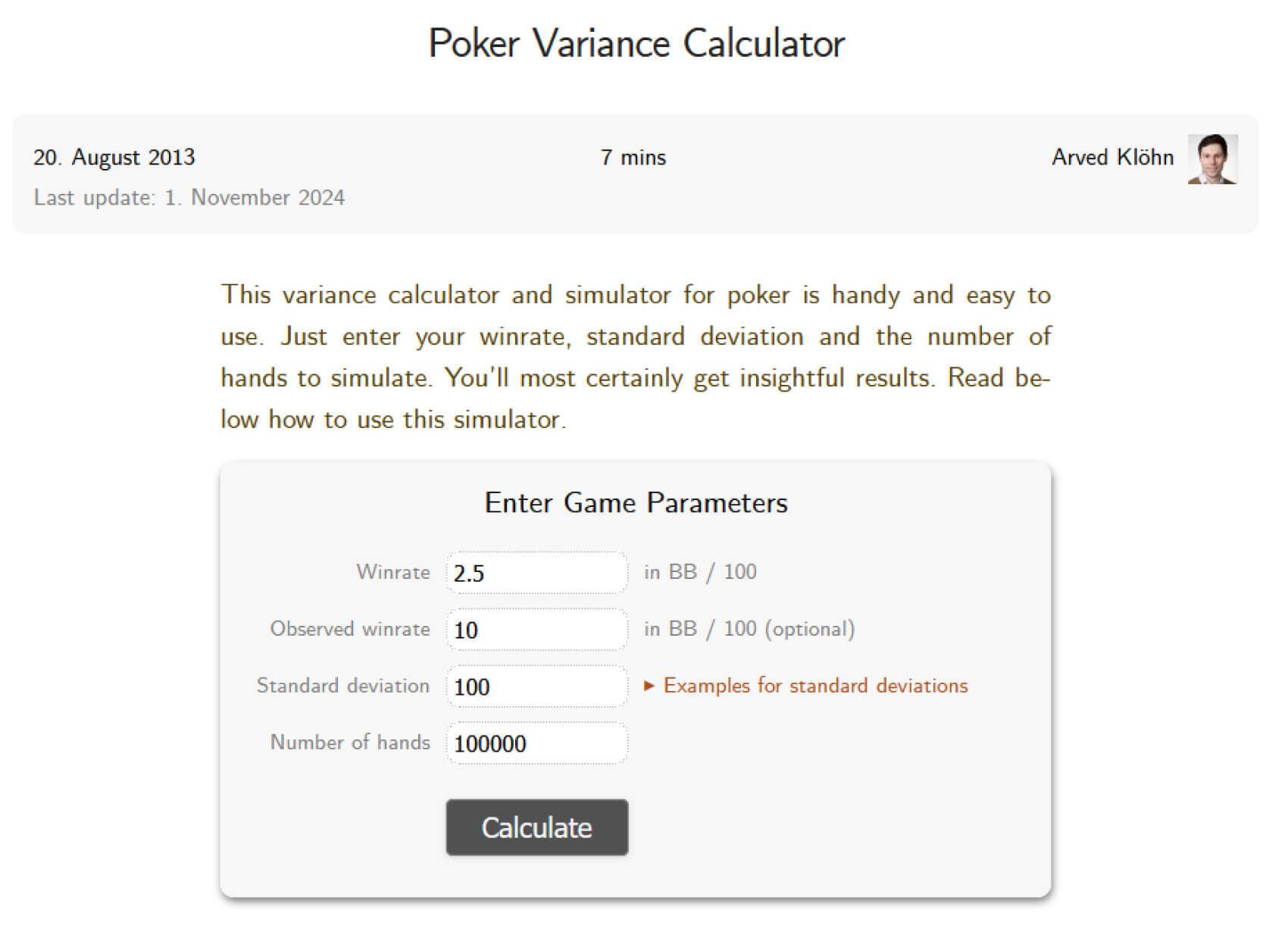
Firstly, to get any results, you need to input a few variables: your assumed win rate in BB/100 hands (if your poker room allows hand tracking, you'll find it in your tracking software - Hold'em Manager or Poker Tracker), observed win rate (which you can omit), standard deviation (it's another term from statistics; there are a few predefined values to choose from) and the number of hands to simulate.
Let's see the results for the assumed win rate of 5 BB/100 hands, with a standard deviation set to 140 after 10,000 hands.
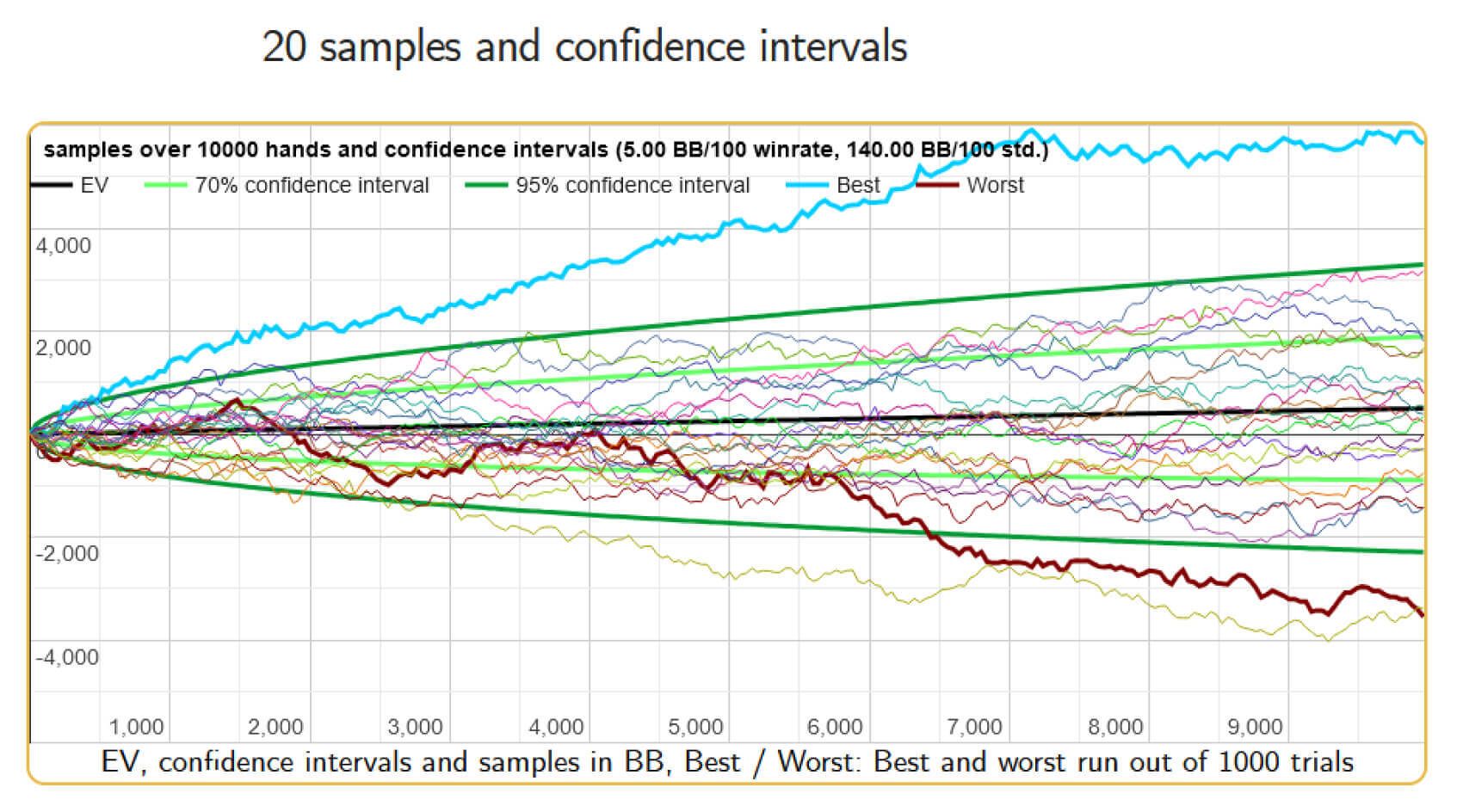
How do we study this data? The graph above shows the results of 20 theoretical samples, covering different possible outcomes.
The light blue line shows the best possible outcome; in our case, it'd be winning roughly 5,400 Big Blinds (which equals 54 stacks, an insane result for 10k hands if you think about it). The brown line refers to the worst possible outcome, which equals minus 4,100 BBs. The dark green lines represent the 95% interval, meaning that 95% of the time, your result will be in this range.
In our case, they span from plus 2,300 BBs and minus 1,900 BBs. Lastly, the light green lines represent the 70% interval, which analogically means that 70% of the time, your results will fall into this area (plus 1,900 BBs and minus 900 BBs).
You can find all of these (with some additional information) in the chart below.
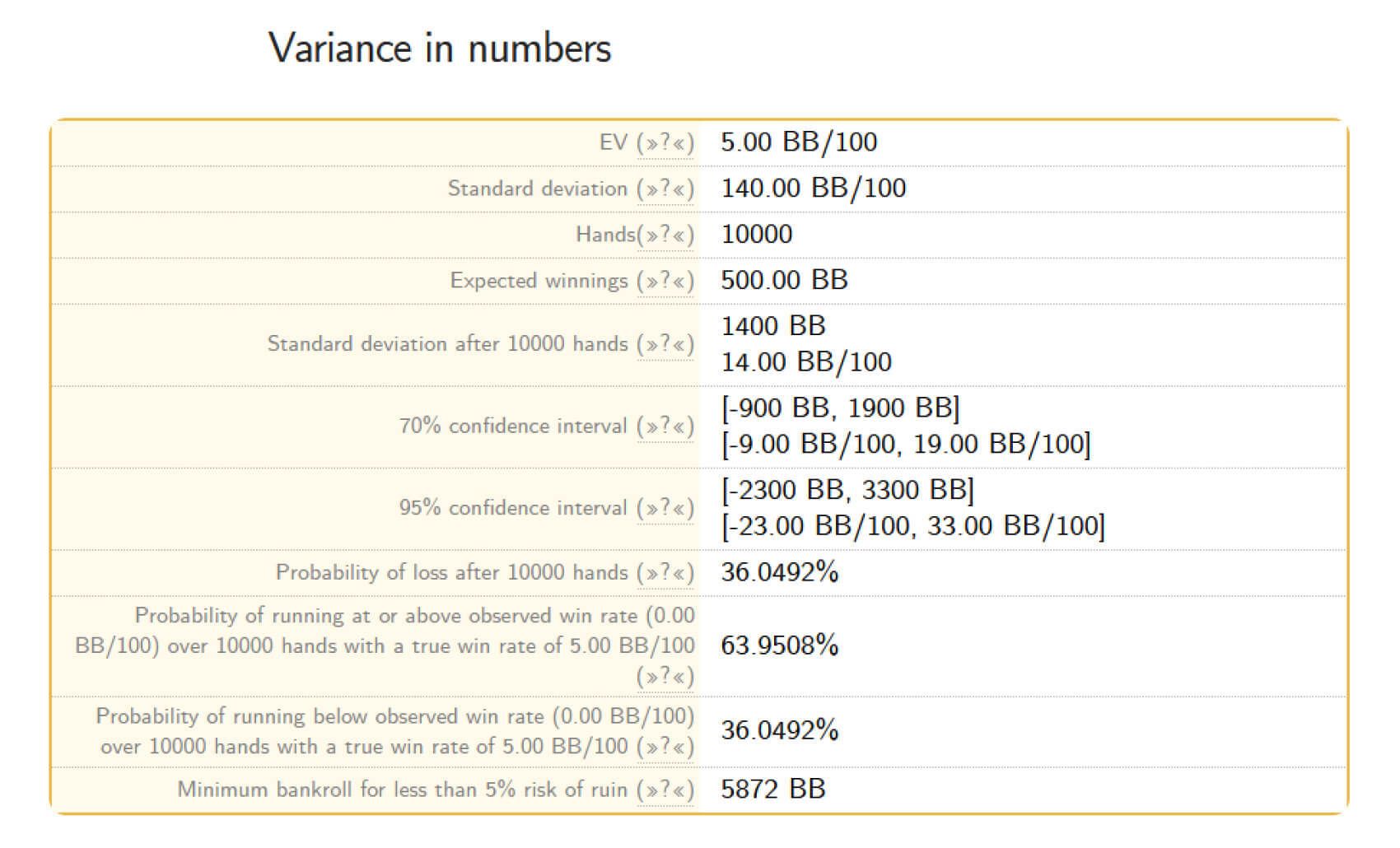
The two most important pieces of information featured in the table are the probability of loss after a set number of hands and the minimum bankroll to keep the risk of ruin low. In our case, that's 36% and 5,872 BBs, respectively.
How do we interpret those numbers? These results, as with many things in poker, are very contextual. The best way to get a better understanding of how variance works is by running the same simulation with a different set of data. In other words, toy with those values yourself and determine how the results change if your win rate gets higher or lower. What about simulating 5, 10 or 25 as many hands?
After running a few different simulations, it will be much easier to estimate how big your swings can be, what to expect when playing a certain amount, and how big your bankroll should be.
How significant should the number of hands be to simulate?
It heavily depends on a few variables that differ from player to player. How many hands do you play daily, weekly, or monthly?
Being a winning player doesn't mean much when it comes to small sample sizes. We strongly recommend simulating the 100K+ number of hands. To put these in perspective, after changing 10K hands to 100k hands, the probability of loss drops from 36% to 13%, and when set to 500K hands, your result will be negative in only 0.6% of cases.

Pot Limit Omaha is a game where variance influences your results significantly. Work done with the Variance Calculator will provide you with a better understanding of how "luck" can influence you in PLO.
How can you take advantage of all of that data?
A few things to consider for every aspiring poker player are their playing routines.
How much time a week do you spend playing?
Are you a player that focuses on quality or quantity?
How many tables do you play at once?
Many players try to play as many tables as possible, but that influences their win rate.
If player A (let's call him Daniel) plays only 4 tables with a win rate of 10 BB/100 and 50K hands per month, he can expect to win as much as player B (Phil), who plays twice as many hands (100K) on twice as many tables (8) with only half as much of a win rate.
While the result may be the same, the overall experience will differ for both players. Phil is much more likely to play in a so-called autopilot mode with much less time to think about the present hands, facing multiple decisions simultaneously. On the other hand, Daniel plays in a less stressful environment; he has more time to think about his choices and can apply new concepts while thinking about his opponent's tendencies.
What might be surprising for some is that Daniel's risk of ruin is much lower (around 12% assuming 50K hands with a 10 BB/100 win rate) than Phil's (around 5.5% assuming 100K hands with a 5 BB/100 rate) despite having the same expected result of 5,000 BBs. At the same time, achieving a higher win rate keeps Daniel's mindset healthier and makes the game feel like less of a grind, while Phil is likely to play more to pursue the result he expects to achieve.
So, what bankroll is suitable for you to play PLO?
One of the beauties of poker formats is the intricacies and nuances which result in a lack of one-size-fits-all solutions. Putting their play patterns aside, what will work for Daniel won't work for Phil and vice versa. With that in mind, how should you perceive your bankroll management when playing Pot Limit Omaha?
In our opinion, the best (and by that, we mean conservative) starting point is the 100 buy-ins per limit rule. It assumes that you start with 100 buy-ins at your current stakes and treat 100 buy-ins for the next limit as the threshold before changing stakes. After some time, you'll find out what works best for you and whether you should keep even stricter bankroll management or you can play your best game with only 50 BIs.
Whatever your opinion on this topic is, it always helps to find out what other poker players take. A great place to do so is the PLO Genius discord server, where you can find other PLO community members striving to improve!
The other half of the preparation is the strategy itself: PLO Genius shows you the equilibrium play for the spots that generate most of the swings. The free Starter plan covers 100bb preflop for heads-up and 6-max, in four-card and five-card PLO, with the trainer and no time limit.

Subscribe to our newsletter
Stay up to date with our new features
Join our community on Discord!
Want to learn more about PLO?
Catch up on our latest articles, updates, and insights

How to Get More Out of PLO Genius
Get more out of your PLO Genius study sessions with these practical tips.

How Rake Changes Your PLO Preflop Strategy: Low vs. High Stakes
Does higher rake mean you should play tighter in PLO?

How Stack Depth Affects PLO Preflop Strategy
What changes preflop when stacks go from 100bb to 200bb in PLO: RFI, 3-betting in and out of position, with numbers from the Compare tool.
